


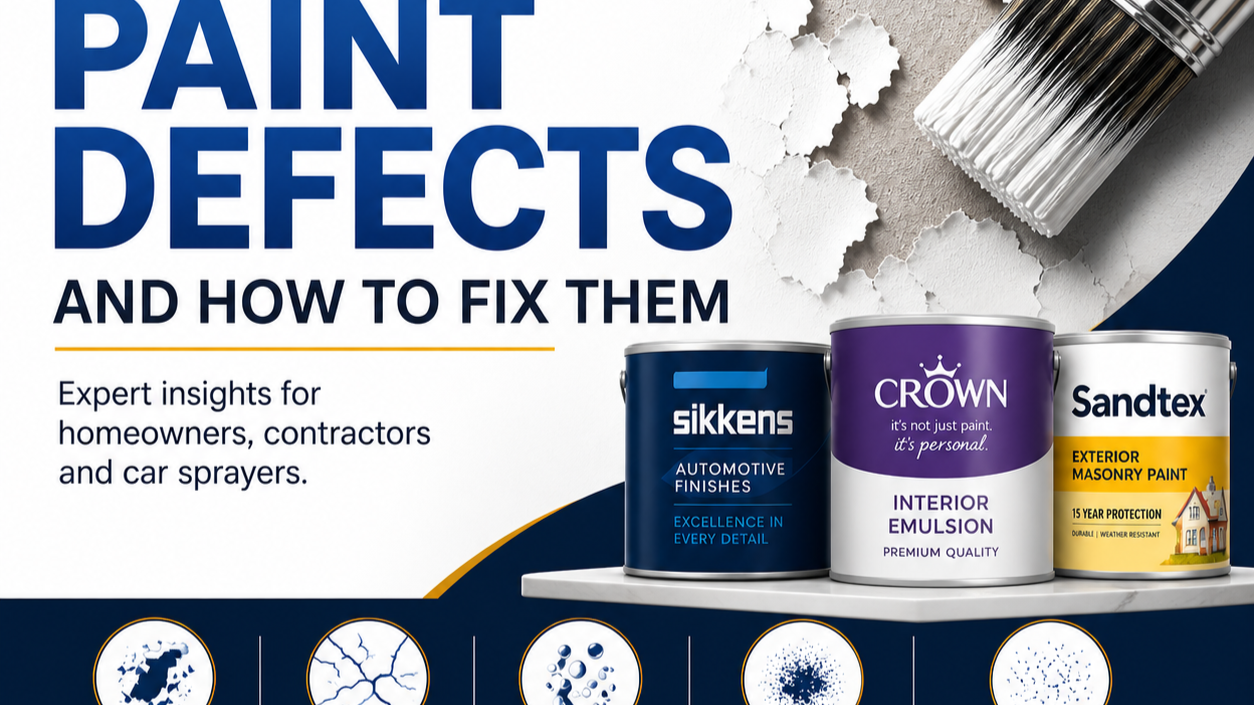
I have observed lately how a lot of clients get confused when they see what they termed as marks and signs on their walls. Most often, they are divided between whether it is the wall or the paint. I concur; it is indeed sometimes confusing seeing what looks like a crack on your wall with marks yet don’t know what exactly it is to do with that.
In most cases, those who have ideas on what they are, only considers repainting the entire house on the plan that until the issue gets escalated to the entire building. But that should not be the case, you can fix that defect with easy fix approaches.
But here is the fact, a perfect paint finish is rarely about the paint alone. It is the outcome of preparation, product selection, environment, and application discipline working together. Yet across residential, commercial, and automotive projects, paint failure remains one of the most common and costly issues in the coatings industry.
Industry data shows that over 65 percent of paint failures are linked directly to poor surface preparation. That single insight explains why even premium coatings can fail while average products sometimes perform well in the hands of skilled professionals.
The Real Reason Paint Fails
Before diving into specific defects, it is important to understand the pattern behind them.
Across industry studies, most paint failures fall into three root causes:
- Poor or incomplete surface preparation
- Moisture and environmental exposure
- Incorrect product or application method
Whether you are painting a living room, a commercial façade, or a vehicle panel, the science remains the same. Paint must bond, cure, and perform under real world conditions.
This is why high-performance systems from brands like Sikkens, Crown Paints, and Sandtex are engineered not just for aesthetics but for adhesion, flexibility, and environmental resistance.
1. Peeling and Flaking: The Adhesion Failure
Peeling is one of the most visible and most reported paint defects across all segments.
At its core, peeling is an adhesion problem. The paint simply does not bond properly to the surface beneath.
What the data tells us Industry analysis consistently shows that adhesion failure is strongly tied to poor cleaning, contamination, or skipped priming.
Typical causes
- Dust, grease, oil, or old unstable paint layers
- Moisture trapped beneath the coating
- Painting over glossy or chalky surfaces without preparation
Professional fix
- Remove all loose paint completely.
- Clean and sand the surface.
- Apply a compatible primer before repainting.
For exterior environments where moisture is a constant factor, systems like Sandtex are specifically designed to improve adhesion and resist weather driven failures.
2. Cracking and Crazing: When the Film Breaks
Cracking and crazing signal structural weakness in the paint film. What starts as fine lines often develops into full coating failure.
What the data tells us Cracking is frequently linked to excessive paint thickness, improper curing, or using coatings that lack flexibility for the surface movement.
Typical causes
- Applying paint too thickly in one coat
- Recoating before proper drying
- Using rigid coatings on flexible surfaces
Professional fix
Sand down the damaged area and rebuild the coating system correctly with proper film thickness and drying time.
Interior systems from Crown Paints are formulated to balance durability with flexibility, reducing the risk of cracking in interior spaces.
What is that common defect that keeps attacking your painting? Tell us and we will help you address it professionally.